
Overview of the De Lay Laboratory
What do we study?
Our research is currently focused on two major research areas. First, we are investigating how
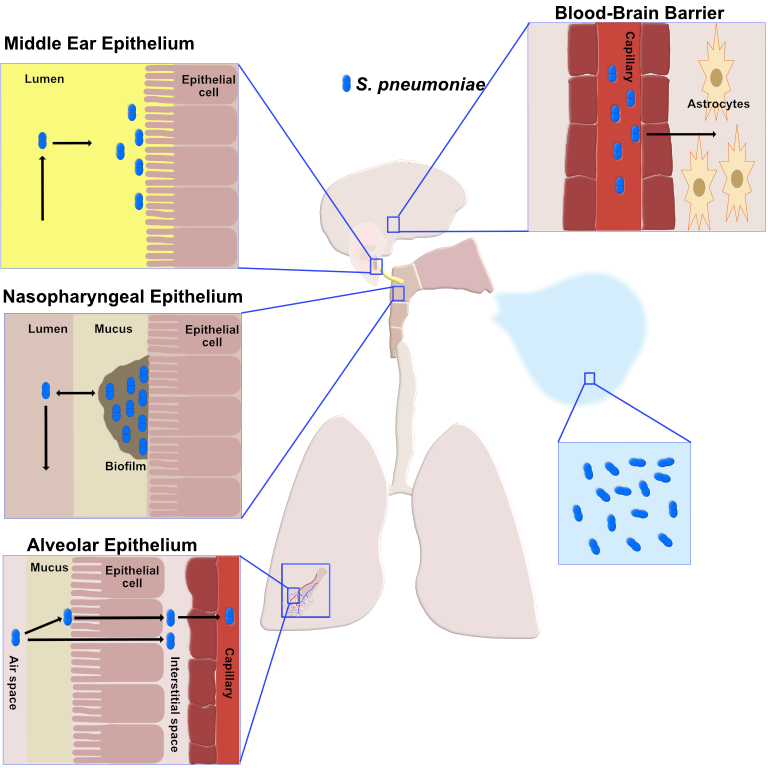
Streptococcus pneumoniae
S. pneumoniae is a common colonizer of the human upper respiratory tract where it can reside as a commensal within complex communities called biofilms. However, in response to certains stresses or other signals S. pneumoniae can disseminate into other host tissues causing invasive pneumococcal diseases. Different strains of S. pneumoniae have different propensities to infect various human tissues, but overall, S. pneumoniae strains can invade the blood, lungs, and brain to cause sepsis, invasive pneumonia, and pnemocococal meningitis, respectively. As S. pneumoniae invades and colonizes distinct tissues it is exposed to different host cells and environmental conditions and must adapt to its surroundings. To adjust to these changing conditions, S. pneumoniae regulates the expression of particular proteins by controlling the synthesis and turnover of their respective mRNAs, i.e., the instructions for making a particular protein. Currently, we are focused on understanding:
- how do sRNAs modulate the adaptation or response of S. pneumoniae to changes its environment in order to promote its colonization and dissemination within a human host.
- how do S. pneumoniae small regulatory RNAs, which are typically 100 nt or less in length (hence small) interact with mRNAs to control their synthesis, turnover rate, or ability to interact with the ribosome and be translated to make proteins.
Treponema pallidum subsp. pallidum
T. pallidum is a corkscrew shaped, gram-negative bacterium that causes the human disease called syphilis. T. pallidum is transmitted from person to person through direct contact with a syphilis sore during vaginal, anal, or oral sex (sexual) or from mother to baby during pregnancy (congenital). How T. pallidum infects a human host, what tissues it colonizes during the different stages of syphilis, and what T. pallidum proteins are important for its colonization and dissemination within and between hosts remain largely unknown. We are interested in determining:
- the different tissues that T. pallidum colonizes during the course of an infection.
- which proteins are needed for T. pallidum to successfully infect and colonize distinct tissues within its hosts and what the function of these fitness or virulence factors are.